




Baton or dynamite?

Index
«Dear parent-entrepreneurs, you are passing me a stick of dynamite instead of the baton, so that it explodes in my hands, and everyone thinks I’m just a spoiled idiot.»
An account of what I have learned about generational handovers, without crucifying children and grandchildren (that would be too easy!).
Long ago, I was leading a project for a family business, and they brought the owner’s young, fresh-graduate son onto the team. I gave the young man an operational task: film the line workers while they performed certain operations with their “tricks of the trade,” to then use those videos during training.
Given it was the young man’s first-time shooting videos, I gave him two simple instructions:
- «Hold the phone horizontally, as the videos will be shown on a projector in a training room.»
- «Make sure to focus on their hands, because that’s where most of the key information is.»
Despite following the textbook rule of “delegate by explaining the rationale,” the videos arrived strictly shot vertically. All you could see were the operators’ shoulders, with no sign of their hands.
So, I brought out the feedback textbook and went through the steps with my young colleague, concluding with the decision: as embarrassing as it was for me to ask the team for another day of filming, we had to reshoot them. He clearly expressed his disapproval.
A couple of days later, he came back to me:
«I spoke with my father. He said the videos are fine as they are and not to reshoot them, especially since it would make us look bad.»
Too bad I was the one who had to deliver the training session, and I would be the one left defending this “important project” in front of the line workers. I could already picture their objections, which indeed arrived right on cue: «Well, professor, you can’t see a damn thing in this video!»
I’ve memorized the neat little lesson that I never fail – I only learn (besides getting angry). So that day, I learned that theories on how to manage people to get the best out of them will likely fail when family relationships get in the way.
Careful not to take the bait
Does this story sound familiar? The father works hard, and the idiot, spoiled-rotten son destroys everything?
I know, I triggered your confirmation bias (“Yet another case of foolish children squandering their parents’ capital”). What’s more, I also exploited attribution bias: knowing that many of you would need to assign blame to someone, I offered you an easy scapegoat to sacrifice, already bound by the legs and lying on the altar.
The anecdote is true, and I too have seen children unfit to take the helm of their father’s company.
But our confirmation bias is always lurking. To avoid it, we need to be more clear-headed when tackling this topic, because things can actually be done right.
Now let’s see what I mean by telling you about what I have witnessed firsthand: when I saw parents who, aware of holding a stick of dynamite, first defused it by removing the fuse, and only then built the path to pass the baton.
And the relay race metaphor couldn’t be more fitting: in a relay, there is a stretch of track run together, giving the runner receiving the baton the time and space to gain speed and avoid losing ground during the handoff.
That is why I believe a small exercise in intellectual honesty is worthwhile: when a phenomenon recurses with high statistical frequency across whole generations of entrepreneurs, blaming solely the last actor to enter the scene is a reassuring narrative shortcut that explains very little.
In fact, there is a widespread belief in Italian family capitalism, a sort of unwritten proverb handed down almost as religiously as Sunday ragù recipes: the grandfather founds the business, the father grows it, and the grandchild, right on cue, manages to destroy in just a few years what previous generations spent decades of sacrifice building.
The problem with proverbs, however, is that while they sometimes summarize folk wisdom well, other times they act as a sort of cognitive sleeping pill, simple formulas that prevent us from examining complex phenomena.
The numbers, at least on the surface, seem to confirm this narrative.
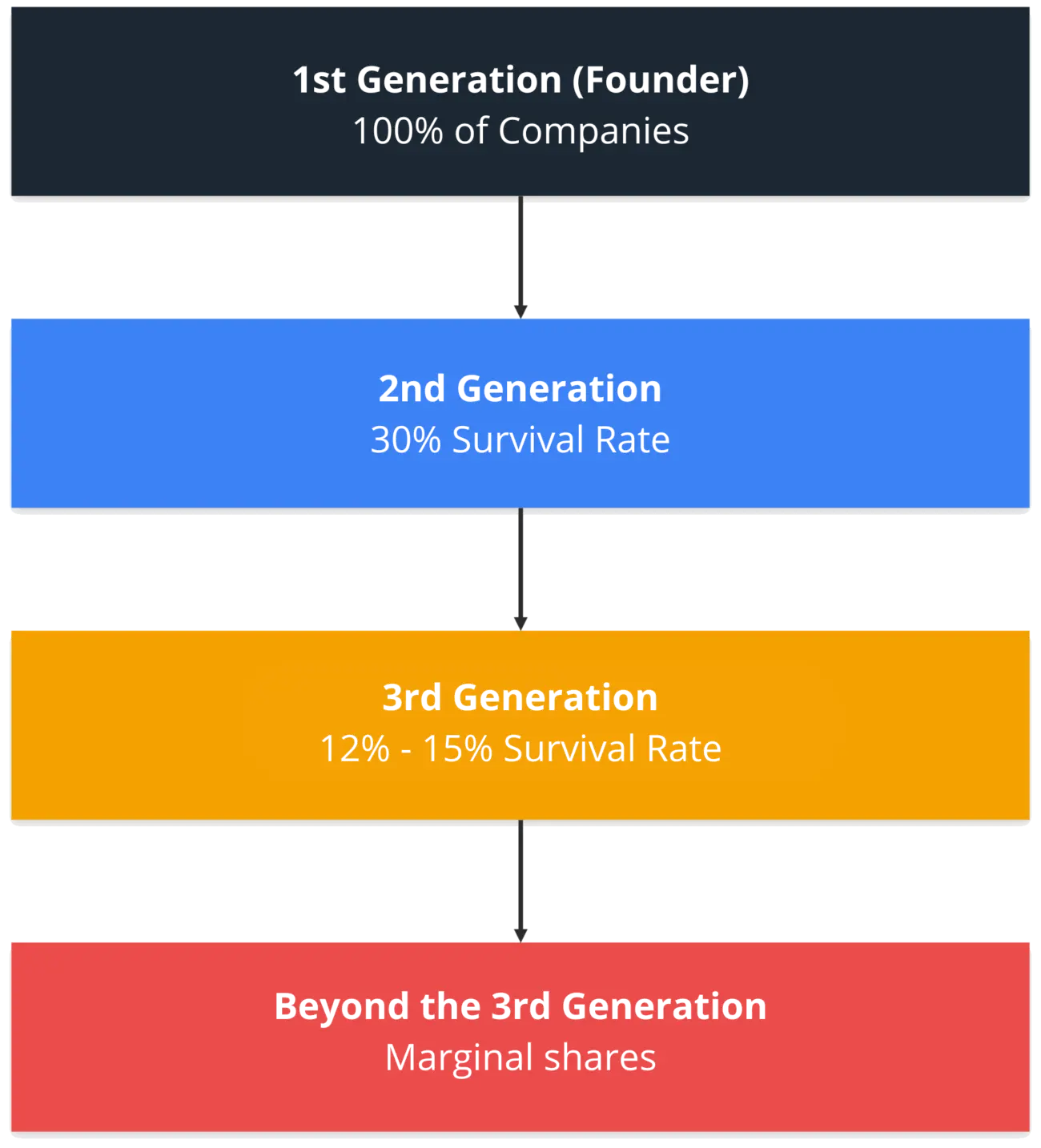
According to the Family Firm Institute:
- About 30% of family businesses manage to survive the first generational handover;
- Only between 12% and 15% successfully reach the third generation;
- An even smaller percentage manages to survive beyond that.
Read this way, it might almost seem like we are facing a sort of genetic decay of entrepreneurial talent, as if there were a mysterious gene that allows the founder to build, the child to maintain, and the grandchild to make decisions so disastrous that everything blows up. And these figures should be weighed against the normal life expectancy of companies, which has been shrinking for the past century because, needless to say, changes are overwhelming.
Before accepting this explanation, however, it would be useful to recall a fundamental distinction that any first-year statistics student should learn long before figuring out how to use Excel to create a pivot table: correlation and causation are two profoundly different things.
If we observe that during the summer months both ice cream consumption and the number of drownings along the Italian coast increase simultaneously, we are not entitled to conclude that pistachio is a potentially lethal substance. There is a third variable, namely the heat, that influences both phenomena.
The problem is that with family businesses, we often make the exact same logical error: we observe that many companies run into trouble by the third generation and decide far too quickly that the cause is the incompetence of the children or grandchildren, without seriously questioning what happened before they took the helm.
Between external managers and heirs, the former seems to be faring better: but why?
In 2008, two Italian economists, Marco Cucculelli and Giacinto Micucci, published a study in the Journal of Corporate Finance that, in my opinion, should be required reading for many entrepreneurs long before they even begin discussing generational succession. The study, titled Family Succession and Firm Performance: Evidence from Italian Family Firms, analyzed a broad sample of Italian manufacturing companies to observe what happened to the firm’s economic performance when the founder decided to step down from operational leadership.
Cucculelli and Micucci built a database of 3,500 Italian manufacturing companies; of these:
- 2.300 were still led by the founder;
- 800 had been passed on to a family heir;
- 400 were managed by an external manager outside the family.
For their performance analysis, they then selected 229 companies that had experienced success between 1996 and 2000 and for which three years of financial data before and three years after the handover were available.
It was on these companies that they measured the evolution of two financial indicators: first, the return on assets (the ratio of revenue to total balance sheet assets, known in English as Return on Assets or ROA); and second, the return on sales, the ratio of operating income (EBIT) to revenue, known in English as ROS (which stands for Return on Sales).
Indeed, the authors divided the sample into two distinct groups: in the first, operational control was passed to a family heir; in the second, it was entrusted to an external manager.
- Companies entrusted to an external manager maintain significantly higher levels of profitability and margins compared to those handed over to a family heir. The difference is substantial and remains so even after econometric controls.
- The drop in performance is concentrated primarily in companies that were the top performers in the sample prior to the succession.The more profitable a company the founder had built, the steeper the performance decline tended to be when management was passed to the heir.
- The negative impact of family succession increases in industries characterized by higher competitive intensity.In markets where managerial adaptability is more critical, the gap between family succession and an external manager becomes even more pronounced.
At this point, it would be very easy to jump to the laziest conclusion of all: children are less competent than external managers.
The problem is that the study does not show this at all.
The economists are not measuring the heirs’ IQ, nor are they evaluating their managerial talent. They do not tell us whether they work less than their parents or spend their days parking their SUV outside Twiga. The study highlights an empirical phenomenon, but we still need to understand the underlying causal mechanism. And this is where far more interesting factors come into play than the old refrain about spoiled children.
To the entrepreneur, the company is like a daughter: ’Nu pezz’ ’e core
To an entrepreneur, the company is a piece of their heart and soul, not the abstraction defined in Article 2555 of the Italian Civil Code: “the complex of organized assets created by the entrepreneur for the exercise of the business.”
To better understand why so many intelligent entrepreneurs stubbornly keep postponing the professionalization process that would make their business more autonomous and likely more solid in the long run, a very curious study published in 2007 by José Manuel Gómez-Mejía and his research team in Administrative Science Quarterly comes to our aid. The group of scholars decided to observe hundreds of Spanish family businesses operating in the olive oil sector, a choice that might seem bizarre, but which in reality offered an almost perfect experimental setting.
During that period, many of these companies were facing a strategically delicate decision. They had the opportunity to join large second-tier industrial cooperatives: consortium structures that allowed them to pool production, achieve economies of scale, improve bargaining power with international distribution, and, in purely financial terms, increase profit margins quite predictably. In short, the classic scenario where any business administration textbook would expect an almost automatic response: if the transaction improves future financial prospects, the entrepreneur joins.
And yet, something very interesting happened.
Analyzing the data, Gómez-Mejía observed that a significant portion of family businesses systematically refused to join these cooperatives precisely in cases where membership would have meant a reduction in the owning family’s direct control over the business. In other words, entrepreneurs chose to deliberately forego economically advantageous opportunities just to avoid situations where they would have to share strategic decisions with external parties or limit their direct power over the company. At that point, the researchers faced an interesting anomaly, because the observed behavior seemed to contradict one of economic theory’s most classic assumptions: the idea that a business should make decisions aimed primarily at profit maximization.
The explanation offered was elegant and, in my view, tremendously human. According to Gómez-Mejía, many entrepreneurial families are not just protecting economic assets, but also a form of invisible assets, made up of:
- the need to maintain control of the business;
- the desire to preserve the symbolic value of the family name associated with the company;
- the wish to continue feeling like the decision-making core of that system;
- the deeply psychological need to avoid losing a part of their personal identity.
Put in less academic terms, the founder is often running a business while simultaneously protecting something they perceive as an extension of themselves. And it is for this very reason that truly professionalizing the company becomes a step that is as economically rational as it is surprisingly costly on a psychological level, because it means slowly beginning to build an organization that, one day, will no longer need you.
The advantage of being and staying an outsider
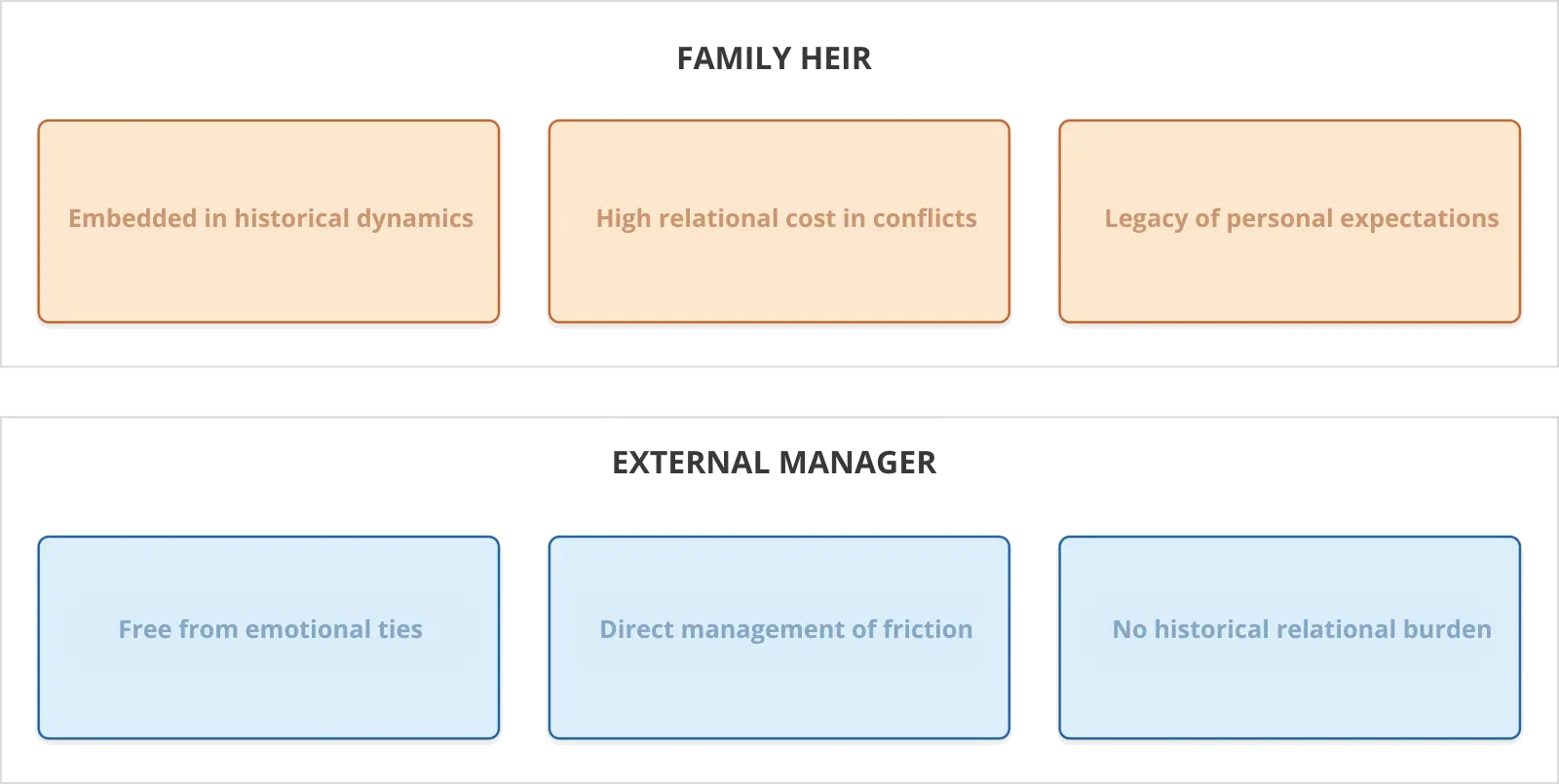
The second interpretive lens for Cucculelli and Micucci’s analysis is good old operant conditioning, straight out of Skinnerian memory. In very simple terms, someone observing a system from the outside can often make decisions that those living inside that system for years can no longer make. Not because they are smarter or more competent, but because they are not trapped within the patterns of reinforcement and punishment: that network of relationships, mutual favors, fears, old alliances, and latent conflicts that inevitably condition anyone who has inhabited the system for a long time.
As a consultant, I see this dynamic constantly, and I suspect a large part of why we will continue to have work even after AI is precisely thanks to this mechanism. Companies often call us in to drive changes that many insiders have seen clearly for years but haven’t been able to carry out, certainly not for a lack of technical skills, but because those inside the system cannot afford to spark certain conflicts.
I, on the other hand, enjoy a nearly unfair advantage: I can afford to tell a sales director that certain practices must change, I can question long-standing habits, disrupt deeply rooted balances, and, above all, I can do so while accepting a level of friction that people living in that environment every day could never tolerate. Quite simply because, once the project is finished, I go home, while they have to face each other again the next morning.
An external manager stepping into the founder’s shoes finds themselves in a very similar position. A son, daughter, or grandchild, on the other hand, inherits something vastly different from what we commonly imagine, and that is the heart of the problem!
To prepare for an Ultrarun, you have to start with the 10k, there’s no way around it
Many entrepreneurs believe they are leaving a company to their children. In reality, very often, they are transferring an organizational system that keeps functioning solely due to their constant presence, their personal relationships, and a massive amount of tacit knowledge that was never truly converted into method, procedures, or autonomous structures. Think about it through a running metaphor.
An entrepreneur founding a small business grows alongside it. At first, they tackle relatively simple problems; then, progressively, they deal with larger clients, more complex production lines, new markets, and more sophisticated financial challenges, building skills gradually.
This is exactly what happens to a runner who starts by running ten kilometers, then prepares for a half marathon, subsequently tackles a full marathon, and, after years of training, decides to try an ultrarun.
When the child enters the picture, however, they do not follow the same path.
Often, nobody signs them up for the ten-kilometer race. Nobody has them run the half marathon. Very often, they are placed directly on the starting line of the ultrarun, with the small detail that the father has developed muscle, technique, endurance, and adaptability by gradually facing each phase of business growth, while the child suddenly finds themselves immersed in forty years of accumulated complexity. And this complexity, far too often, has not been transformed into a structured organization.
Almost mandatory steps for a successful succession
If you truly want to increase the likelihood that the generational handover won’t turn into a predictable disaster, there are certain responsibilities that lie far less with the children and far more with the parents, and grandparents, currently running the business:

- Company structure: If you haven’t formalized your processes, optimized them, digitalized them, and made them independent of the individual people overseeing them today, you are leaving behind a fragile system. A healthy organization should continue to function decently even when a few key individuals temporarily step out of the room. If, on the other hand, everything continues to depend on knowledge informally stored inside people’s heads, you haven’t built a robust company, just a web of personal dependencies held together by force of habit.
- Internal leadership: If every major decision still requires your final say, and if your executive team isn’t yet capable of working together with mutual trust, coordinating, making decisions, and managing conflicts without the founder constantly stepping in as referee, supreme judge, company confidant, and ultimate guarantor of internal peace, then the problem isn’t your child’s future incompetence, it’s that you haven’t built a mature organization yet.
- The relationship between family and merit: A serious family agreement should make it clear from the outset that the right to join the company does not simply stem from having the right last name printed on your ID card. Anyone aspiring to lead the business should first gain real professional experience, preferably in other companies, build independent skills and experience the fact, pedagogically very useful, that in the rest of the world, your surname does not automatically generate authority, respect, or fast-tracked promotions. If you want to prepare a competent successor, the primary goal shouldn’t be to protect them, but to empower them.
- Leadership transfer: In the minds of many entrepreneurs, generational succession is still imagined as a sudden, almost bureaucratic handoff, a sort of notarized deed disguised as an organizational succession. In reality, for the system to remain stable, employees, suppliers, clients, and partners must perceive continuity. What is needed is a transition phase where the outgoing leader gradually steps back and the incoming leader progressively gains autonomy, ensuring the entire organizational ecosystem views that transition not as a traumatic rupture, but as a change within continuity.
Mom, dad: for a while we have to run together
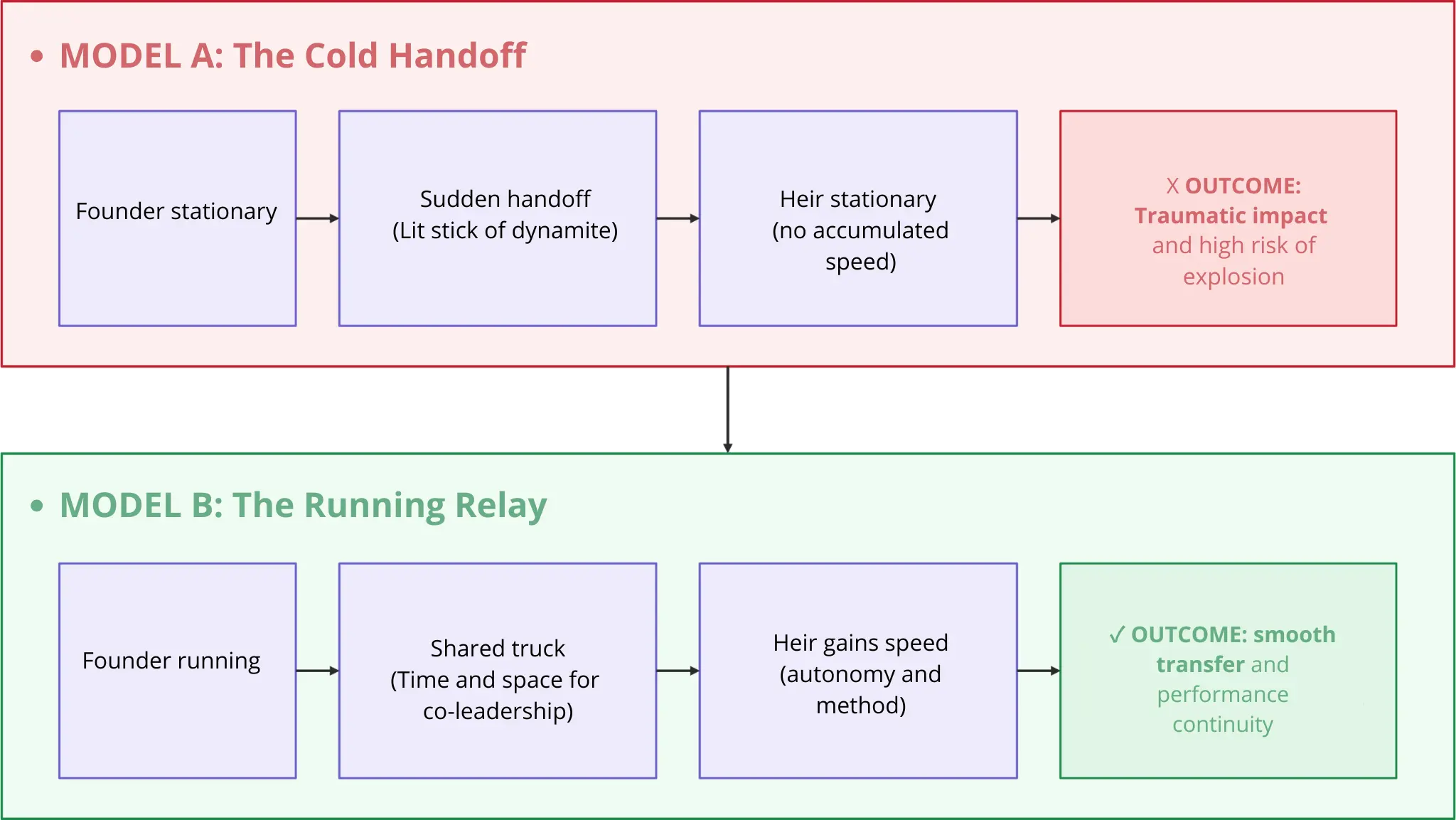
And this is where the relay race metaphor comes back into play, which, when you think about it, is infinitely smarter than it seems. In a relay, the runner receiving the baton doesn’t start from a standstill the exact moment their teammate hands it over. There is a precise zone where both athletes run together, because only by sharing the same track for a stretch is it possible to transfer momentum without losing ground.
Well, in my experience as a consultant who has witnessed or guided professionalization processes and generational successions, the risk for entrepreneurs is leaving it too late to reach this relay zone: the baton turns into a lit stick of dynamite, and when something inevitably explodes, they find it immensely reassuring to say that young people today just aren’t what they used to be.
That may be so, but before complaining about your son, your daughter, or your grandchild, it might be worth asking yourselves whether you have built an organization capable of surviving without you.
Because the true generational succession doesn’t begin on the day the entrepreneur decides to leave the company, but on the day that entrepreneur makes peace with their own ego and their sense of social responsibility prevails: at that moment, they begin to build a business that no longer needs their shadow.
Next time, we will try to understand how to practically guide this delicate overlap zone between the outgoing and incoming leaders, and we will see that in certain circumstances, having two leaders at the helm is not a problem to be avoided, but paradoxically, the best solution to ensure that change within continuity we have discussed so far.
Article written by:

Alessandro Valdina
Principal
His academic background spans Communication, Finance, and Applied Behavior Analysis. His areas of expertise cover Reorganizations, Change Management, Strategy Deployment, Lean Office, Performance Management, Leadership Development, and Training Technologies.
Having joined Lenovys in 2017, he is active in management consulting, corporate training, and public speaking. Since 2025, he has been producing “Io so’ io e voi non siete…” (“I am who I am and you are not...”), a newsletter and podcast exploring the relationship between power and corporate organization in Italy, offering Lean and Agile insights for improvement.
Read more


Upcoming events