



VUCA World: Farewell to the Traditional Supply Chain
Everything that could be said or written about adopting a Lean Supply Chain to eliminate waste and maximize results has likely already been covered. These applied principles and methodologies have become so widespread and universally accepted that Lean Supply Chain management is now almost considered a commodity, hardly a novelty to write about or a groundbreaking topic of conversation.
And yet, upon closer inspection, even though every aspect of the subject appears well-known, a new element emerges, one capable of sparking fresh reflections and different operational approaches, if we broaden our perspective to include the context in which we live and operate.
Products, the companies that manufacture them, and the supply chains underpinning production and distribution systems are immersed in an environment that, since the late 1980s, has been defined as V.U.C.A. (Volatile, Uncertain, Complex, and Ambiguous).
Undoubtedly, the 2020 pandemic—with the restrictions imposed on our private lives and the upheaval of global production—has documented and made even more evident how extremely fluid, interconnected, and complex this context is. It has highlighted the danger of underestimating this reality, as even seemingly minor events can escalate into significant disruptions to the established order.
This awareness alone should drive us to re-examine the design of corporate supply chains with fresh eyes, considering this transformed – and constantly evolving – landscape.
Today, more than ever, a company’s actual profit margins are determined by a series of costs that escape the logic of standard cost accounting.
These costs, unpredictable and linked to inefficiencies generated by complexity and uncertainty, are amplified by the typical dynamics of a VUCA world; they are increasingly relevant and can no longer be overlooked.
Such inefficiencies can be viewed as a true ‘loss system’ (and a system of waste) inherent to the adopted operating model, predominant behaviors, and the specific Supply Chain design chosen.
Learning to recognize one’s own ‘loss system’ and investigating its root causes—by utilizing Lean techniques such as Problem Solving and Value Stream Mapping, while understanding the level of flexibility already embedded in business processes but not yet fully exploited, has become more urgent than in the past.
What does a “loss system” look like?
A “loss system” consists of two major categories:
- On one hand, there are the classic wastes found in Lean literature (the 7 muda: overproduction, waiting, defects/errors/rework, unnecessary motion, unnecessary transport, excess inventory, and over-processing). These are tied to internal processes and the behaviors of the people managing them;
- On the other hand, there are systemic wastes linked to the very structure of the Supply Chain (how my product is designed, where my suppliers are located, how I manufacture, how I distribute, etc.) and its strategic focus (efficiency vs. flexibility, Make vs. Buy, Sell IN vs. Sell OUT, etc.). These are often defined by predetermined choices.
All these wastes carry a cost, often poorly measured, that is increasingly becoming the differentiator between companies that thrive and those that fail. The path forward is clearly mapped and well-known, yet the countermeasures are not always obvious. Let’s look at how we should proceed.
On one hand, tackling the family of classic wastes is possible by applying the guiding principles for creating a Lean Supply Chain:
- Eliminate all process waste (the 7 Muda)
- Make the customer visible to all members of the value stream
- Reduce lead times
- Create leveled flow (Heijunka)
- Implement ‘Pull’ systems for production and distribution (driven by the customer)
- Increase speed and decrease process variability through standardization
- Establish collaboration and discipline among all members of the value stream
- Focus on the Total Cost of Fulfillment (Total Cost to Serve)
On the other hand, before tackling systemic waste, it is necessary to confront certain implicit beliefs that drive predetermined choices. These assumptions must be challenged in order to find solutions capable of improving profitability in a VUCA world.
These implicit beliefs, which often describe and reference a world that no longer exists, will remain unchallenged until they are made explicit and clarified. Until we fully understand their impact on choices, behaviors, and results, it will be impossible to question them, let alone change course.
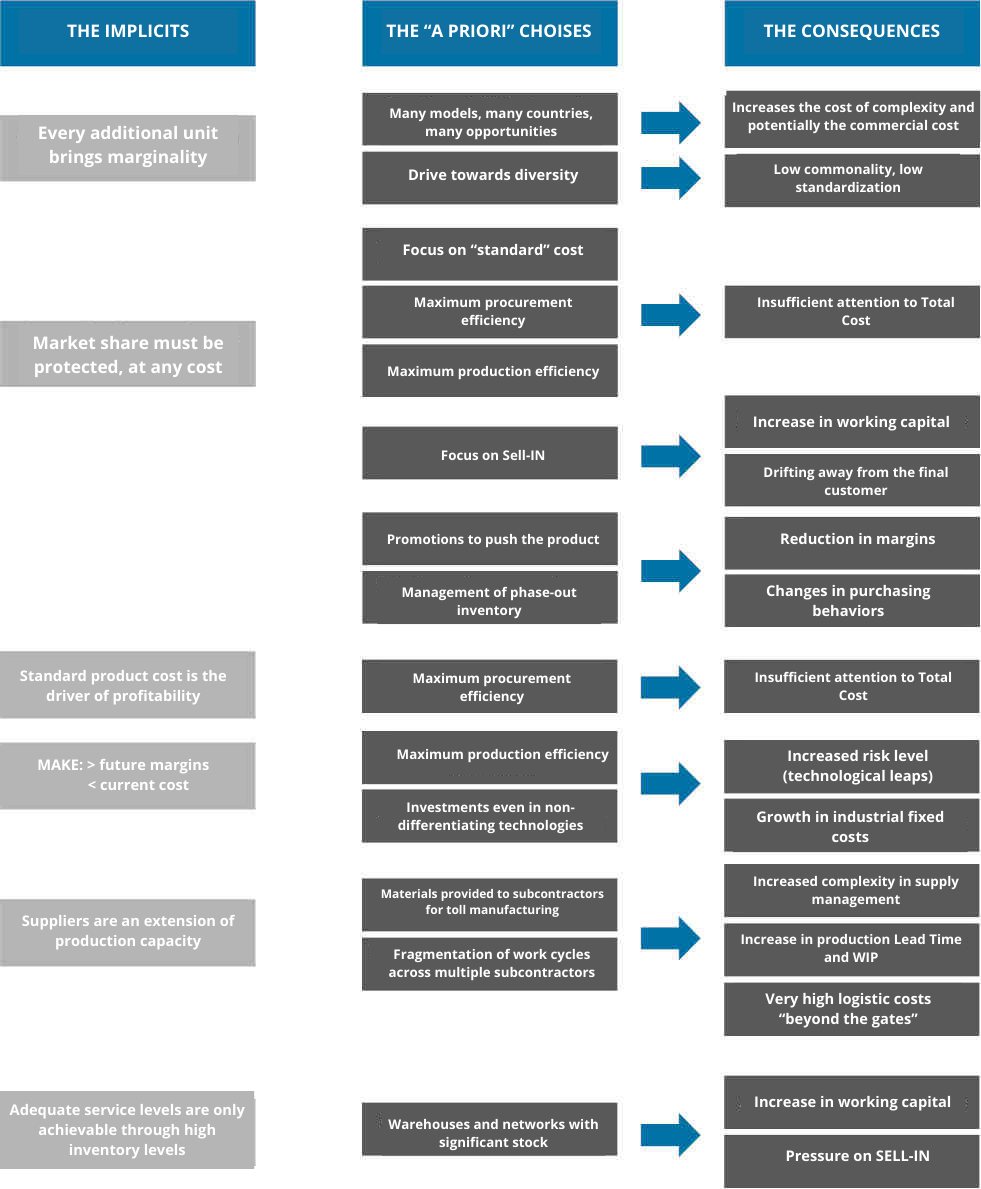
Here are some examples of implicit assumptions that can influence, often without full awareness, Supply Chain choices, models, and behaviors.
The true turning point lies in understanding the chain of consequences triggered by these ‘implicits’. Only then can we have all the necessary elements to challenge the status quo and transform the company’s results and profitability.
Moving away from the ‘One size fits all’ principle, which is fundamentally unsuited for modern Supply Chains, the real challenge is to identify the root causes of the ‘loss system’ and map them across the different stages of the operating model (R&D, Procurement, Production, Sales, etc.). At that point, the goal is to define a plan of ‘local’ interventions that are internally consistent yet manageable for the organization.
A common example of an ‘implicit assumption’ found in almost every company relates to sales volume forecasting, which subsequently constrains all decision-making processes, from sourcing and procurement methods to production and warehouse management.
Despite knowing that any forecast is based on a probability of realization, one that varies and often decreases as volumes increase, once a ‘magic number’ is defined, all other processes treat it as a deterministic value and organize accordingly. This inevitably leads to unpleasant surprises such as excess stock, under-utilized capacity, obsolescence, and fire sales.
Challenging the deterministic nature of forecasts allows us, for example, to ‘slice and dice’ sales volumes: identifying a ‘hard core’ of guaranteed sales, additional quantities driven by sales force activity, and ‘aspirational’ goals. By linking the probability of realization to specific actions (such as promotions or discounts), companies can build more flexible models that are far less sensitive to uncertainty.
To summarize, in the face of the heightened variability typical of the VUCA world we live in, entrepreneurs and companies must develop the ability to incorporate levels of uncertainty into their business processes. This is the only way to effectively modulate their activities and enhance their responsiveness to the environment.
A necessary path in VUCA times
What practical advice can we offer companies to manage their supply chains in a VUCA context?
While solutions vary based on product types and target markets, we can certainly identify a common denominator: the integration of probability, flexibility, and extended visibility across the entire Supply Chain.
We can also outline a structured roadmap to meet today’s challenges and safeguard corporate profitability:
- Map and measure the “loss system” inherent to your Supply Chain, specifically as it relates to Volatility, Uncertainty, Complexity, and Ambiguity
- Trace back to the root causes of these losses and identify the process or function where they originate
- Identify the implicit assumptions driving these losses and verify their validity within the current landscape
- Apply Lean Supply Chain guiding principles to aggressively tackle classic waste
- Evaluate and implement alternative scenarios (regarding processes, structure, and focus) and test their sensitivity to uncertainty and complexity to eliminate systemic waste
- Implement decision-making processes (for defining supply chain structure) that incorporate robust scenario-based assessments
Article written by:

Matteo Gottardi
Principal
With twenty years of experience as a consultant, he has developed extensive knowledge on issues of the Supply Chain, Project and Program Management, product development and operations, in strategic and organizational areas, in industries such as Industrial equipment, Automotive, Chemicals and FMGC. He has worked for Artesana, Tetra Pak, Biticino, Case New Holland, Pirelli and Ferretti Yatch. He has worked with the MIP and IPSOA on numerous corporate lectures, testimonials, and publications on supply chain and Revenue Management.
Read more