





Digital Transformation: Jingle or Jungle?

“Digitalization”, “Digital Transformation”, and “digitizing” are words and concepts that echo through the workplace like a jingle – a repetitive, increasingly common refrain.
In fact, digital transformation today is an imperative for all companies, without exception. It is no longer a matter of turnover or headcount, nor is it a solution reserved for specific industries. Every organization must build new capabilities to harness the potential of emerging technologies, learning to integrate them into their processes, organizational models, and daily operations.
The pandemic has undoubtedly acted as an accelerator, pushing this need forward at high speed. For SMEs, digitalization is now a mandatory step. They cannot afford to miss this opportunity, even if their resources are more limited than those of global corporations. Precisely for this reason, it is essential to manage capital and digitalization processes with extreme care and strategic awareness.
The stakes are incredibly high (customer-centricity, increased productivity, and process simplification are all on the line) and failure should not be an option. Yet, unfortunately, according to recent research by the Boston Consulting Group, only 30% of transformation initiatives succeed.
Consequently, the impact in terms of financial investment, organizational effort, and waste is staggering. We must, therefore, examine the reasons behind such frequent failures. Implementing such a substantial change is a daunting task, and the challenge only grows as organizations become larger and more complex.
While technology undoubtedly plays a key role in digitalization projects, it must never be the primary driver. The human dimension (encompassing organization, operating models, processes, and culture) is a decisive factor that cannot, and must not, be overlooked.
If these core principles are ignored when leading a project, digitalization initiatives risk turning into true nightmares, becoming as difficult to escape as a dense and tangled jungle.
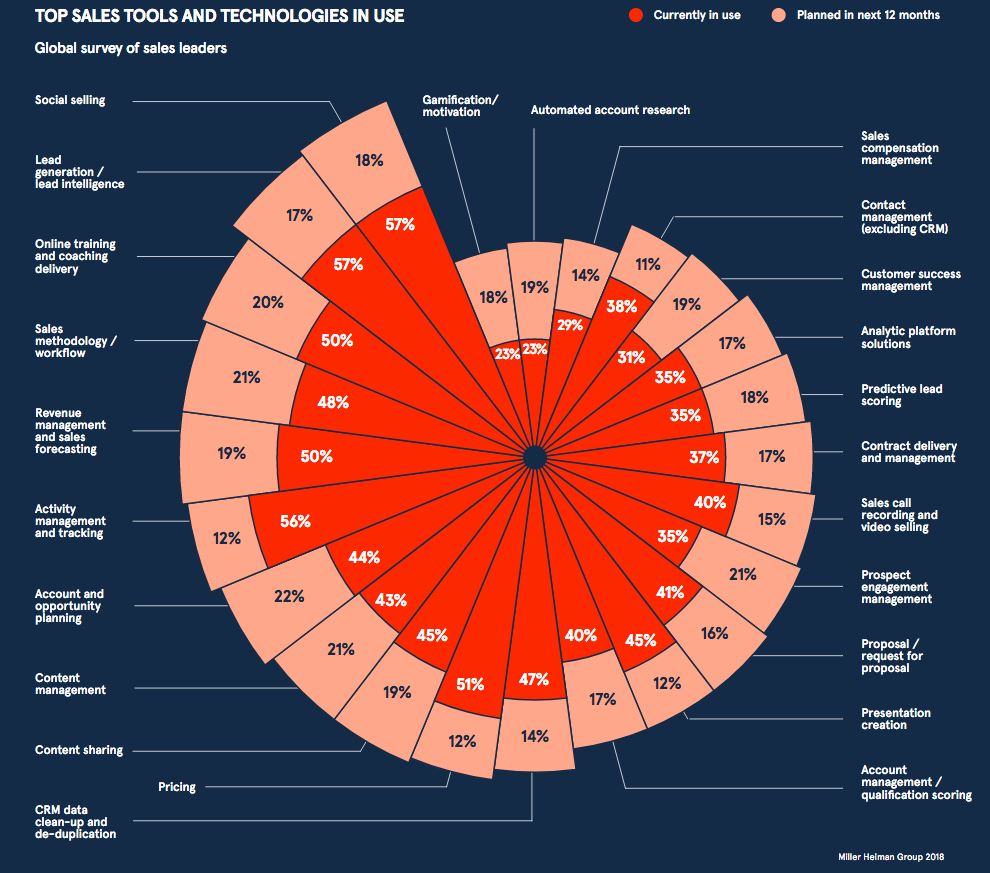
A typical case of digitalization, to use a simple example, is the purchase of software to digitalize a company’s commercial processes. Even looking at just this “slice” of the business world, the infographic shown here highlights more than 20 different processes (and sub-processes), each represented and driven by specific technologies and logic.
Technology is omnipresent and permeates every aspect of our lives, creating an excessive complexity that we are clearly struggling to manage. Consequently, all too often, we make choices without a clear understanding of the problems we are trying to solve through a specific technology. Alternatively, we may be driven by ideas or impulses that are not strictly aligned with the corporate strategy and mission but are rather a response to the need for quick, short-term fixes.
This is precisely what happens when we decide to purchase software (sometimes involving significant financial investments, perhaps totaling several hundred thousand euros) without being certain that it will solve the company’s current problems. This occurs because, at the outset, no contextual analysis was carried out, nor was there any mapping of the issues intended to be addressed and resolved.
Returning to the metaphor of the dense and tangled jungle that the digitalization journey can become, it is like trying to build a shelter to live in the wild without even having clearly identified the goal. Are you planning to stay in the jungle, or are you searching for a way out?
And yet, even though the scenario appears critical, tangled, and filled with potentially valid solutions, this does not mean we should give up on making choices. Instead, it is crucial to learn how to find our bearings and understand: why, how, when, and what to digitalize (fully aware that not everything needs to be done at once).
Focusing on needs and problems to find your north star
A vast and diverse array of options, limited knowledge of the available solutions (including the strengths and constraints inherent in every choice), and all too often, a lack of clarity regarding both the objectives to be achieved and the problems to be solved: this is the typical context in which digitalization projects are launched. Usually, while the variables and conditions may vary in complexity, these challenges remain constant, regardless of the size or scale of the organization.
All too often, decisions (whether operational, tactical, or strategic) are made without being goal oriented. Instead, the focus shifts toward the immediate resolution of a problem, frequently without even identifying its true root cause.
The following is a list of typical problems and errors that occur in scenarios where a comprehensive mapping has not been established prior to the digitalization process:
- Technology-driven choices guided by technical aspects rather than actual processes or the pursuit of customer value;
- Lack of stakeholder involvement, leading to a disconnect between the goals of digitalization and the change process that people must face and overcome;
- Choosing a technology partner or vendor that is disproportionate to the actual needs, perhaps driven solely by the urge to find a partner quickly to get the project started;
- Creation of disparate digitalization projects that proceed in parallel but independently from one another, without establishing the necessary fluidity and data continuity between different departments;
- Costs and inefficiencies created by non-value-added activities required to update and integrate systems that were not conceived or designed as natively integrated and collaborative.
It is now clear that launching a digitalization process means analyzing, rethinking, and redesigning business processes to fully leverage the automation and control that technological platforms offer. However, beyond choosing the right partner for technical and digital support, it is essential to foster a widespread awareness of the change. Engaging people is crucial to prevent discrepancies between digital and real-world processes. Without this alignment, organizations risk developing a fragmented collection of different systems in the medium-to-long term, rather than a fluid and integrated ecosystem.
While it is true that digitalization projects often suffer from runaway costs and timelines, this most frequently happens when there is no comprehensive, integrated guidance to oversee the entire transformation, a process that must evolve simultaneously across Processes – Organization, and Technology.
A widespread and shared Lean Digital Mindset across all business areas, one that maintains a relentless focus on maximizing customer value throughout the project’s development, is an indispensable asset for success. It is therefore fundamental to establish a Lean Digital Mindset that defines a broader strategic framework. This framework must accommodate the opportunities and demands of multi-year goals, enabling and facilitating the achievement of specific corporate strategic objectives by clarifying the interconnections between technological levers and business impacts.
A roadmap to tackle the challenge
To successfully navigate the challenge of digitalization, it is necessary to work on the following pillars:
1. Customer centricity
The heart of Lean Digitalization is the customer, whether internal or external to the company.
A successful Lean Digitalization approach, therefore, starts with understanding the customer’s problems and deciding which aspects of business processes to digitalize, and in what order, to increase the value provided to the end customer. Identifying the specific value that external customers recognize and are willing to pay for is of fundamental importance. It allows for a correct digital strategy that aligns with the corporate vision, ensuring that digitalization does not become a mere “trend,” but serves as a genuine turning point for business results.
It is therefore vital to establish and maintain customer centricity and a relentless focus on their needs and the value generated throughout the entire transformation journey.
2. Lean Digital Mindset
It is fundamental to establish a Lean Digital Mindset that enables the definition of a broader strategic framework. This framework must accommodate the opportunities and requirements dictated by multi-year goals, using Lean Digitalization to enable and facilitate the achievement of specific corporate strategic objectives. This is achieved by clarifying the interconnections between technological levers and their direct business impacts.
3. Agile Target Operating Model
The AgileTOM approaches transformation by focusing on the entire value chain, maintaining a constant approach based on the Lean philosophy of continuous improvement (Kaizen).
Beyond serving as a compass to stay oriented toward value, it simultaneously allows for the definition of process improvements to make them leaner. Furthermore, it fosters organizational evolution by supporting the processes and functional requirements necessary to select and develop the most suitable software.
4. Lean Change Management
Achieving the implementation goals of a new digital system requires dedicated support throughout the entire transformation journey. People must be guided and supported as they modify long-standing behaviors to fully leverage the potential of a digital transformation.
Communicating the change, defining new behaviors, and supporting them through a structured habit management program are essential elements for the success of these projects.
What we need, therefore, is a way to bring it all together and foster an effective digital transformation, one that succeeds and eliminates the risk of failure. This is achieved by merging the actual needs of the customer and the relentless pursuit of value with a lean and agile approach to digitalization.
Customer centricity, the development of a Lean Digital Mindset, the application of an Agile TOM, and Lean Change Management constitute the pillars that guarantee:
- alignment with corporate strategic aspects and long-term planning
- adherence to the defined digitalization roadmap, preventing “workarounds” aimed at restoring the status quo
- cohesion between different working groups striving toward the same overall objective, to the full advantage of end-customer value
- company-wide engagement, ensuring that everyone feels part of the change and is personally committed to the process.
Article written by:

Michele Bergamaschi
Director
Management consultant with almost 20 years of experience in business digitalization and ERP transformation projects. Extensive and consolidated knowledge of the issues and problems of Supply Chain, with particular focus on the processes of Planning, Sales, Distributions
and Purchasing. He has the technical skills necessary to create integrated models in order to fully structure the potential of the supporting information system.
Read more