



A tool to guide change projects

The web, publishing and newspapers are full of articles on the importance of Change Management, understood as the communication and training tool that allows you to manage change. But have we ever wondered why we should manage change? And above all, do we really think that it is possible to bring all people together at the same time, in the same way, with the same tools to peacefully and happily accept a change?
Is it possible to control and manage change?
Judging by the percentage of failed change projects in SMEs, about 60%, perhaps it is an unprofitable obstinacy.
We do not want to fall into judgments. Nobody questions the skills of managers and the capabilities of the resources that unfortunately fall into that percentage: in our opinion, the expected result was not achieved because the focus was on the wrong asset and tool.
It is useless: controlling change is not possible, and it is not what a person who wants to do Change Management must do.
Better to change, right?
“Better to change, right?” a famous television commercial by a well-known telephone company closed its invitation to potential customers. Too bad that, in reality, people are not so willing to change!
It is quite normal for people to resist and oppose any request for change: it is in human nature to be afraid of change and to do everything to stay within certain and safe boundaries. For this reason, resistance to change is observed even when the change should guarantee improvement compared to the current conditions.
Over the years, Lenovys has followed numerous business transformation projects aimed at transforming companies into Lean Lifestyle Companies, i.e. companies in which results and well-being are not in conflict with each other but can be achieved simultaneously.
To combine results and well-being, a Lean Lifestyle Company acts on 4 main areas:
- Visionary and pragmatic: It knows how to look ahead and how to achieve quickly
- Lean, Agile and Digital: Generates value for itself, for customers and for society without wasting resources
- Effective and with autonomous team: It promotes the rapid resolution of problems where they arise and develops autonomous and responsible teams
- Well-being oriented: It promotes a lifestyle oriented towards physical, mental and emotional well-being, inside and outside the company.
People and companies who have accepted the path of change towards a Lean Lifestyle Company have shown how it is possible to adopt a new way of working in which more results and more well-being are achieved simultaneously (See some stories on Luciano Attolico’s website).
Yet while everyone aspires to achieve more results and more well-being, even in these transformation projects a certain resistance to change is observed.
We shouldn’t imagine protests or demonstrations, resistance to change is more subtle, if we want it more malicious:
- Has a new working procedure been created?
- ma gbut the actors keep using the old one and tell everyone that the new one doesn’t work
- Has a new standard file been created for order management?
- but I create a personal file or use the one out of system
- Is my manager not the same as before?
- but I keep referring to the old manager
There are a thousand ways we can identify resistance to change, which is why Change Management is essential, moving beyond traditional Change Management, which focuses on controlling change, and instead moving on to overseeing Change’s activities, with greater involvement of people, in line with what is described in the Lean Lifestyle Company manifesto.
Having a strategy to support resources does not eliminate resistance but allows us to significantly reduce its manifestation and be prepared to react with functional countermeasures.
Within projects, Change Management has become a bit’ the mirror for larks: too often, it happens that the estimated days are instead used for other project activities and the activities accompanying the change are reduced to training and communication.
Training and communication are certainly necessary, but can they be enough to meet the five pillars that must guide us in Change Management? Clearly not.
Accompaniment to change must necessarily have a technical part combined with a more soft and relational part. Change Management must merge with all project activities: if well structured, it not only supports project users, but also greatly benefits other planned activities.
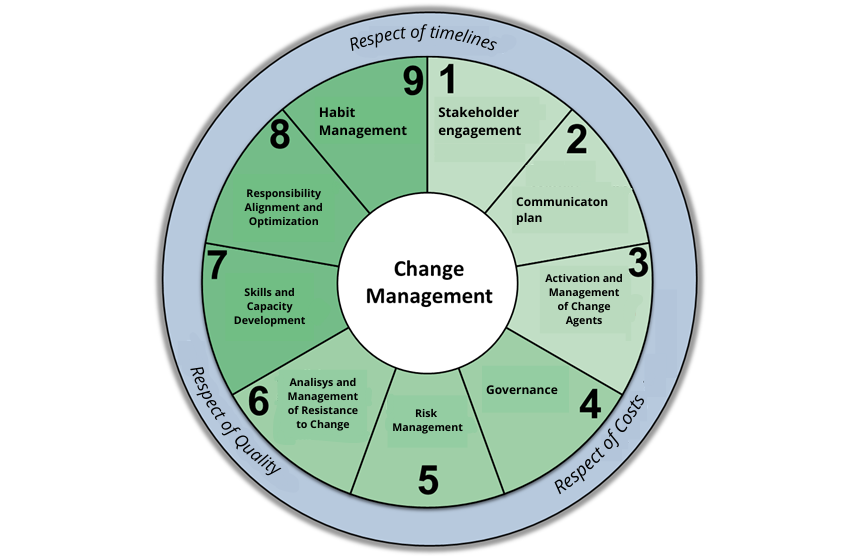
But what are the concrete activities to monitor change?
There are 9 in total, and they are represented by this scheme which in Lenovys transformation projects is called CAKE (Change by Activating Key Elements)
- Stakeholder Engagement: Ensure commitment and constant alignment by project stakeholders
- Communication Plan: Administer the communication process, reshaping its organization step by step
- Activating and Managing Change Agents: Gaining High Penetration and Engagement in Change Through Change Agents
- Governance: Ensuring project success through monitoring and control of all program variables
- Risk Management: Identify program risks by defining preventive actions and, if necessary, corrective actions
- Analysis and management of resistance to change: Manage resistance to change that could lead to project blockages
- Skills and capacity development: Providing users with the key skills to cope with change
- Accountability Adjustment and Optimization: Clarify and share new responsibilities associated with business roles
- Habit Management: Ensuring the sustainability of change through new functional habits
It’s clear now: we can’t apply the same tools, the same activities that are different, and precisely for this reason, the nature of cake is a dynamic nature, applicable to any change project within the company. Depending on the reality or context we encounter, it will be possible to option the most functional “slice” to respond to the specific needs of that context. It would be a mistake to apply them all right away because it could lead to oversaturation or, worse, a loss of focus with respect to project activities.
We don’t want to go into specific detail about each of these nine entries now, because it will be the subject of other blog articles, coming out in the coming months.
Until then, we recommend, do not have the presumption that you can control the change, and choose “the right ingredients” to compose your cake to support the change?
Article written by:

Gianluca Ferrari
già Partner e Executive Director Lenovys
With degrees in economics and clinical psychology, he has over 20 years of experience in strategic consulting, particularly in national and international projects focused on organizational change, talent acquisition, leadership development, and potential enhancement. As a Change Manager, he has led projects to define organizational models that support the achievement of corporate strategy, and to analyze the cultural impacts of corporate restructuring and generational transitions. He has worked in theretail andautomotive sectors, for luxury and fashion companies, and for the mechanical, steel, chemical, and service industries, as well as for banks and insurance companies. Since December 2021, he has been a Lenovys partner.

Federico Visca
già Senior Consultant Lenovys
With a degree in Work and Organizational Psychology, he began his professional career collaborating with the University of Turin on various organizational projects. Specifically, the creation and implementation of a Smart Working system at Ferrero.
At Lenovys, he has worked with a variety of clients across different industries to achieve technical and operational excellence, integrating the Habit Management methodology with the Lean Lifestyle framework.
Read more